Showing posts with label on being chinese. Show all posts

Monday, 11 February 2013

into the new year

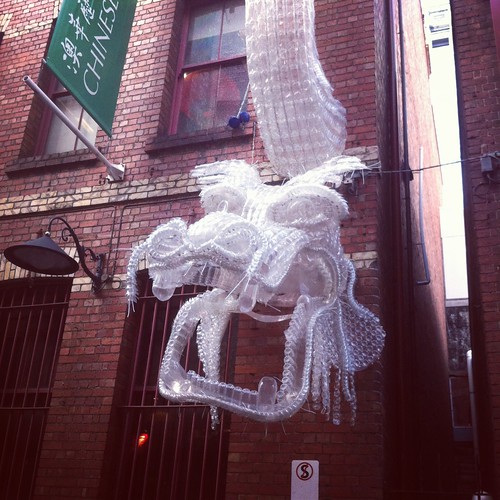
water dragon, claire tracey, 2012 
dragon made of water bottles!
恭喜发财!新年快乐!etc etc

hope the nian was scared away and you got lots of oranges and noodles and good wishes and little sacks of gold (ie, dumplings). i had a dumpling party and failed to take any photos, except of me pulling faces with my decorations, but hayley brought tofu pancakes and catherine made saffron bread shaped like a snake, and everybody wore red and at 1am i called my mother whose reunion party (3 hours behind) was still going, and i had a lovely time.

dumplings are super easy to make, you should make them always

i hope your year is prosperous and golden

and full of noodles

Wednesday, 16 November 2011

me at peril

belated (i just moved countries!), but i have an article up at peril magazine: Care and Feeding: Comfort Food for Chinese-Australian Vegans.

Saturday, 9 January 2010

asian women blog carnival

So one of the reasons why I started this blog was to explore vegan food through my lens as Chinese Australian, and reconcile OMG NO MEAT with a lot of the things I used to take for granted. I have posted a little about it directly, but mostly I just try to find a lot of food that meets my requirements as Chinese and vegan and delicious.

In my Real Life as an occasional anti-racism blogger, I'm hosting the 5th Asian Women Blog Carnival. Posts are welcome from both Asian women and allies. The theme is Who I Am When I'm (not) With You. The full explanation post can be found here, and it contains all the details regarding submissions and guidelines.

I know that there are some people lurking in this blog that would be interested in that, so please, you know, check it out, or consider posting something for the carnival! Submissions are due a few days before CNY.

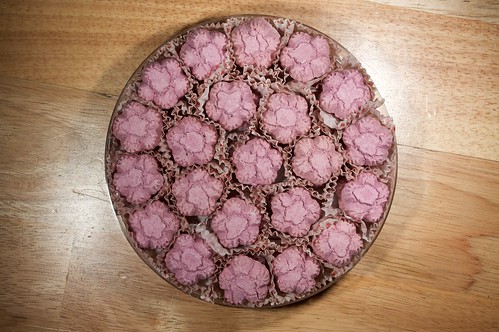
coconut biscuits (kuih bangkit)

Thursday, 7 January 2010

some links and outrage

I may or may not be back with a food post today, but briefly:

Kekovich takes Australia Day lamb campaign global
After five years of campaigning against ‘unAustralian’ behaviour across the nation and urging us to unite over a lamb chop on Australia Day, Sam Kekovich is set to take his cause global.Convinced that mankind is facing a pandemic that threatens its very existence - unAustralianism - Sam will ask the United Nations to declare 26 January ‘International Australia Day’ in his 2010 Address.
OH GOOD because nothing makes me feel better about being a Chinese-Australian vegan than being told I have to kill lambs in order to count as an actual Australian.

Some other links for the morning:

On meat consumption, equity and human rights by Sarah at the Vegan Benefits Blog

Why vegans were right all along at the Guardian.
As a meat-eater, I've long found it convenient to categorise veganism as a response to animal suffering or a health fad. But, faced with these figures, it now seems plain that it's the only ethical response to what is arguably the world's most urgent social justice issue. We stuff ourselves, and the poor get stuffed.
I regularly read vegan.com because Erik Marcus is always talking about and linking to interesting stuff, and he has written The Year in Meat 2009, a really interesting read on animal agribusiness and vegarianism (mostly US-centric) in 2009.

Monday, 15 June 2009

the disconnect of veganism; continuous othering

There's an interesting post at Vegans of Colour on how veganism may disconnect a vegan from their culture: Veganism and Cultures of Origin. In the first year or so, I felt very distanced from the sharing/togetherness of festivals. Getting used to fake-meat products as substitution has definitely helped decrease that distance, particularly as due to their original purpose (as substitute at religious festivals where no meat is eaten) they are tasty and easy to substitute, so often now at festivals we don't have "this is the meat version, this is the veggie version;" instead we have "here are all the dishes," and D and I get to share in the passing of food around the table, in the sharing and the complimenting and the fighting over the last piece. And we get to share in the superstition, the fish for abundance and the duck for prosperity and so on, and these are some of the most important elements of how we propagate our traditions.

Being vegan now highlights and emphasises the difference - as mixed-race, particularly as someone who spent her formative years in Australia, I'm often considered not Chinese enough. Now that I don't eat meat (and don't eat egg tarts), I'm frequently considered not-Chinese enough, and though I've spent years working hard to define my own identity, to be as Chinese and as Anglo and as Australian as I want to be, sometimes being told I'm 'completely westernised' by someone is incredibly demoralising.

I've blogged before about how vegetarianism/veganism is often spoken of as an "ethnic" thing, Asian or African or something "exotic." You can be vegan or not, regardless of your ethnicity, regardless of your cultural background, but it's approached, particularly in Western media and blogging circles, as something that only "ethnic" food lends itself to (and oh, how I hate that word in this context). So it was particularly galling to read an article that was both homophobic as well as othering to the food I grew up with as Chinese, and that I eat a lot of now as vegan, the article is Soy is making kids 'gay.' It's hardly from a reputable source, but galling and othering all the same.

It's like everywhere I turn, as a Chinese vegan, there is an opportunity for me to be categorised as other. It's not as awesome as you might think.

reunion dinner: fish = plenty

Thursday, 7 August 2008

talking about things to eat

It's IBARW this week. I don't talk about racism in this blog, because this blog is just about food. However this blog is specifically about how being Chinese-Anglo by way of SEA and living in Australia impacts my veganism and vice versa, and I'd like to take a moment to talk about food, ethnicity and language.
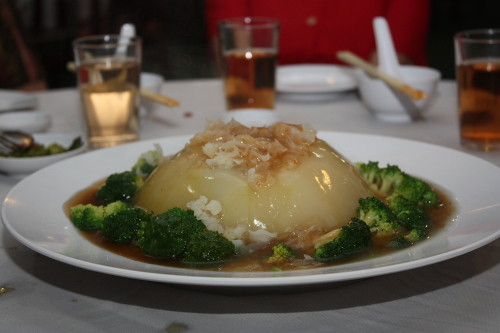
wintermelon

talking about things to eat
(or: how the words people use to describe food make me feel like a freak)


Growing up as a child, I was familiar with roasts and pasta and pizza and sausage rolls and all sorts of different foods, but almost always when I went home we'd be eating the sorts of things my mother ate as a child, Malaysian and Chinese and Indian, for the most part. We used to eat noodles all the time, and I was ten before I found out not everyone ate rice several times a day. I used to go to the Chinese butcher where I'd peer at whole animals and feet and things, but I know that not everyone grew up this way. I know that this is cultural and it is social and yeah, it has a bit to do with being Chinese from Malaysia.

When we first went vegetarian, the problems this caused for my family and the problems it caused for D's family were quite different.

longan

Feeding us at regular family dinners was not a problem for my mother. Chinese cuisine considers meat as just another ingredient, so altering noodles, curries, and other dishes was as simple as exchanging one ingredient for another. Our meals remained mostly the same. My mother didn't blink at the shift to veganism – about 90% of people of Asian descent are lactose intolerant, so we've never been big dairy consumers – though the loss of eggs threw her for a bit. The real intellectual problem came at holiday events, where dishes become less about tradition (which I tend to view as alterable) and more about superstition – I don't eat fish anymore, so how can I court abundance? I don't eat duck, so how can I show prosperity?

Compare this then to D's family, who eat mostly European/English dishes. For D's mother, feeding us was problematic. We were served a whole lot of dishes made primarily of cheese, and Christmas was a meal of boiled vegetables and cauliflower cheese (note to all who have dinner parties at Christmas: this does not count as a meal). The shift to veganism completely petrified D's grandmother, who literally couldn't think of a single dish to serve us that wasn't a garden salad. So this situation is impacting them differently, but they're trying to think outside what is familiar to them, outside their squares, and they're trying new recipes which I think is worrying them, these unfamiliar paths.
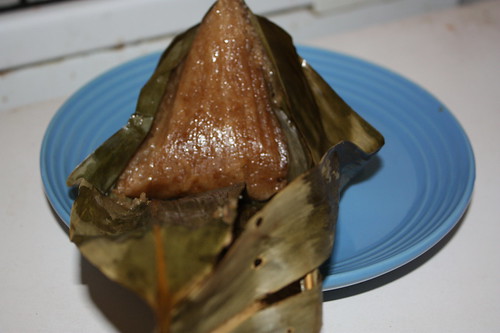
ba cheng

It's interesting, the ways in which we think of food. People have such different backgrounds, and such different habits and histories, but we get used to these things and that's reflected in the ways we think about food. Chinese cooking places so much emphasis on a tiny bit of this, a tiny bit of that, but all elements are essential, and so my mother said to me once, "How can you be Chinese if you don't eat meat?" just the same as I believe she would have asked how I could be Chinese if I didn't eat vegetables, or mushrooms, or rice. Over the years I've become more familiar with English/European food, but it seems so much more focused on the big hunks of things, and so D's family's reaction was (and for some of them, still is) more along the lines of, "But what can you eat?"

I read Jay Rayner's attempt at a week of veganism, where he suggests that "ethnic is the default position for the vegan." I bet he uses 'exotic' ingredients in his cooking, too. I have an ethnicity; we all have ethnicities: the fact that the food I grew up with is easier to veganise than the stuff he ate as a child doesn't make me 'ethnic,' it makes me Chinese. Using these words trivializes the decision I have made to be vegan, and it others my family and my whole freaking life, because using words like that aren't just saying that I'm 'different,' they're saying that I'm 'other.' And he is not alone in this, many people are guilty of this all the time. That you're trying something you've never before heard of doesn't make it 'exotic,' it makes it new to you. And you definitely don't get to describe it as exotic if you're talking about it on the internet - there's a good chance it's not new to your readers. Just because the things I did as a child are different doesn't make me special, and I certainly don't want to feel like a freak. And I realise it's just semantics but semantics are important, because they indicate attitudes - so really, it's not that I have a problem with the word 'exotic,' it's that I have a problem with the attitude that leads to its use, that the food I eat is 'not normal,' that it is other, that I am other.

char kuay teow

A guy I know can't pronounce char kuay teow, he always calls it 'koi char' and he thinks that's hysterical. So he can't pronounce the name of a dish that I've been eating since I was little, growing up in the same country as he did, because it's made up of words he's never been bothered learning. Why is that funny? If anything, it's a little sad for him – I can pronounce everything that he eats. If it's anything else, it's a reflection of his privilege, and it's racist – it's different so it's funny. And it makes me feel like a freak, and it makes me hate him.

My food is not exotic because it's different from your food, it's just my food. And it's not ethnic because that doesn't mean what you think it means. I have enough trouble trying to work out how to incorporate the old food superstitions into my life as it is: I don't need to feel like some sort of foreign novelty whilst I'm doing it. So do me a favour and mind your language.


(With thanks to J + L for reviewing this for me)